Presentation of the IOBE Study – “Trends, Challenges and Growth Prospects of the Construction Sector in Greece – 2025”
A strong recovery of Greece’s construction sector, coupled with positive medium-term growth prospects but also significant uncertainties, is highlighted in a new study by the Foundation for Economic and Industrial Research (IOBE), titled “Trends, Challenges and Growth Prospects of the Construction Sector in Greece – 2025”.
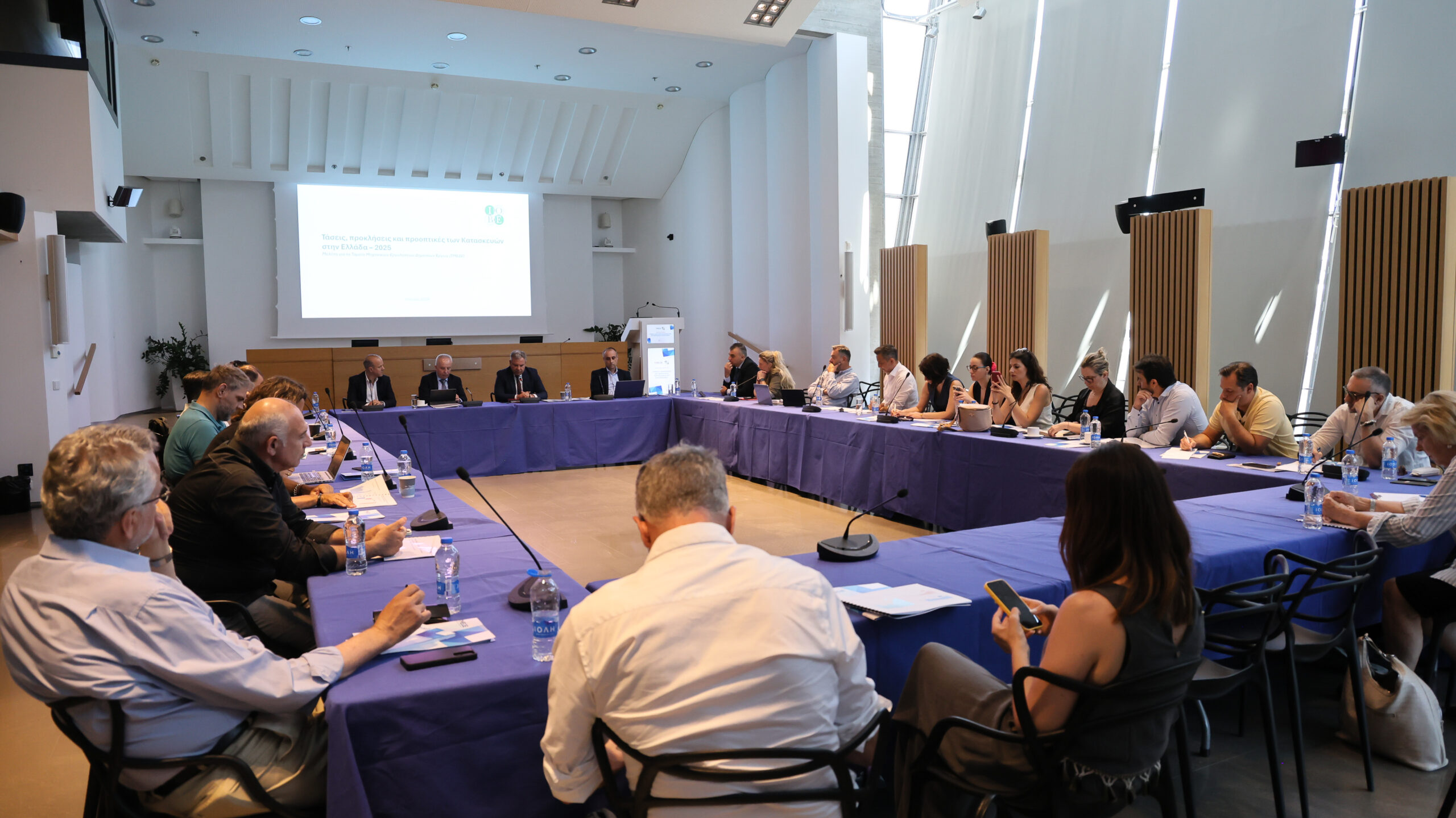
The study was presented at a dedicated event jointly organised by the Engineers & Public Works Contractors Fund (TMEDE), the TEE–TMEDE Institute and IOBE. It documents the substantial expansion of the construction sector, with output more than doubling between 2020 and 2024, and forecasts further growth through 2026, supported by national and European funding resources.
At the same time, the study highlights adverse effects on investment—particularly in residential construction—stemming from regulatory uncertainty, pending legislative adjustments and delays in the completion of spatial and urban planning frameworks. These challenges are linked to recent rulings of the Council of State regarding provisions of the New Building Regulation Framework, as well as restrictions on out-of-plan development.
Investment Outlook and Economic Impact
According to IOBE’s estimates, projects under the Recovery and Resilience Facility (RRF), combined with resources from the 2021–2027 ESPA programme and private investment (including housing), are expected to mobilise more than €31 billion in total resources during 2025–2026, including bank financing. As a result, construction investment—particularly in infrastructure—is projected to further increase its contribution to GDP over the same period.
In 2024, the total production value of the construction sector reached €15.7 billion, up from €7.2 billion in 2020. Employment in the sector rose to 210,000 workers, marking an annual increase of 8.8%, while employment in architectural and engineering activities reached 90,000 professionals, representing a 21% increase compared to 2020.
Construction investment accounted for 6.0% of GDP in 2024, compared to 4.0% in 2020 and 14.7% in 2007, although it remains below the EU-27 average.
Statements by Institutional Representatives
Speaking at the event, Konstantinos Makedos, President of TMEDE, noted:
“For the sixth consecutive year, the study confirms the strong multiplier effect of the technical sector on the Greek economy. This positive trajectory must be reinforced and accelerated. As the IOBE study clearly demonstrates, the sector faces critical challenges, including access to finance, labour shortages, certification of materials and services, cost pricing, the integration of new technologies, infrastructure maintenance, regulatory uncertainty, and the incorporation of climate risk into investment decisions.
Only through a coherent national strategic planning framework—defining priorities, infrastructure needs and funding sources—can we safeguard the sector’s momentum and move confidently into the post-RRF era. TMEDE remains committed to strengthening its guarantee and financing role through modern financial tools and advisory services, particularly in support of young engineers and professionals.”
In his remarks, Nikos Vettas, Director General of IOBE and Professor at the Athens University of Economics and Business, stated:
“The study captures both the opportunities and the challenges facing the construction sector, in close interaction with the broader economic recovery. Fluctuations in construction and financing costs, combined with persistent labour shortages, continue to affect the sector. Nonetheless, its outlook remains positive, supported by the implementation of the Recovery Fund and other financing programmes. Ongoing volatility in international capital and energy markets may, however, have a significant impact on sectoral performance in the period ahead.”
Growth Scenarios and Financing Needs
The study examines two alternative scenarios for the evolution of construction activity during 2025–2026, reflecting differing impacts on residential investment following regulatory changes. Under the baseline scenario, construction investment is projected to rise to 7.2% of GDP by 2026, up from 6.0% in 2024, while total production value is expected to approach €18 billion.
Outstanding bank loans to construction companies reached €3.3 billion in 2024, representing 4.7% of total lending to non-financial corporations. New loan flows to the sector increased to €555 million, up from €349 million in the previous year. However, borrowing costs in Greece remain consistently higher than the Eurozone average, despite a gradual easing since early 2024.
Key Challenges and Strategic Priorities
The study identifies persistent labour shortages, financing constraints and regulatory uncertainty as major challenges. It also underscores the importance of professional certification, skills development, digital transformation—including the adoption of Building Information Modelling (BIM)—and the integration of climate risk and ESG criteria into construction and investment planning.
Furthermore, IOBE highlights the need for a National Strategic Plan for Infrastructure and Construction, which would set clear priorities, align funding resources, define workforce and skills requirements, and contribute to cost control and timely project delivery in the years ahead.
The full study is available here. (in Greek).
The presentation material can be accessed here. (in Greek).
Photo Gallery